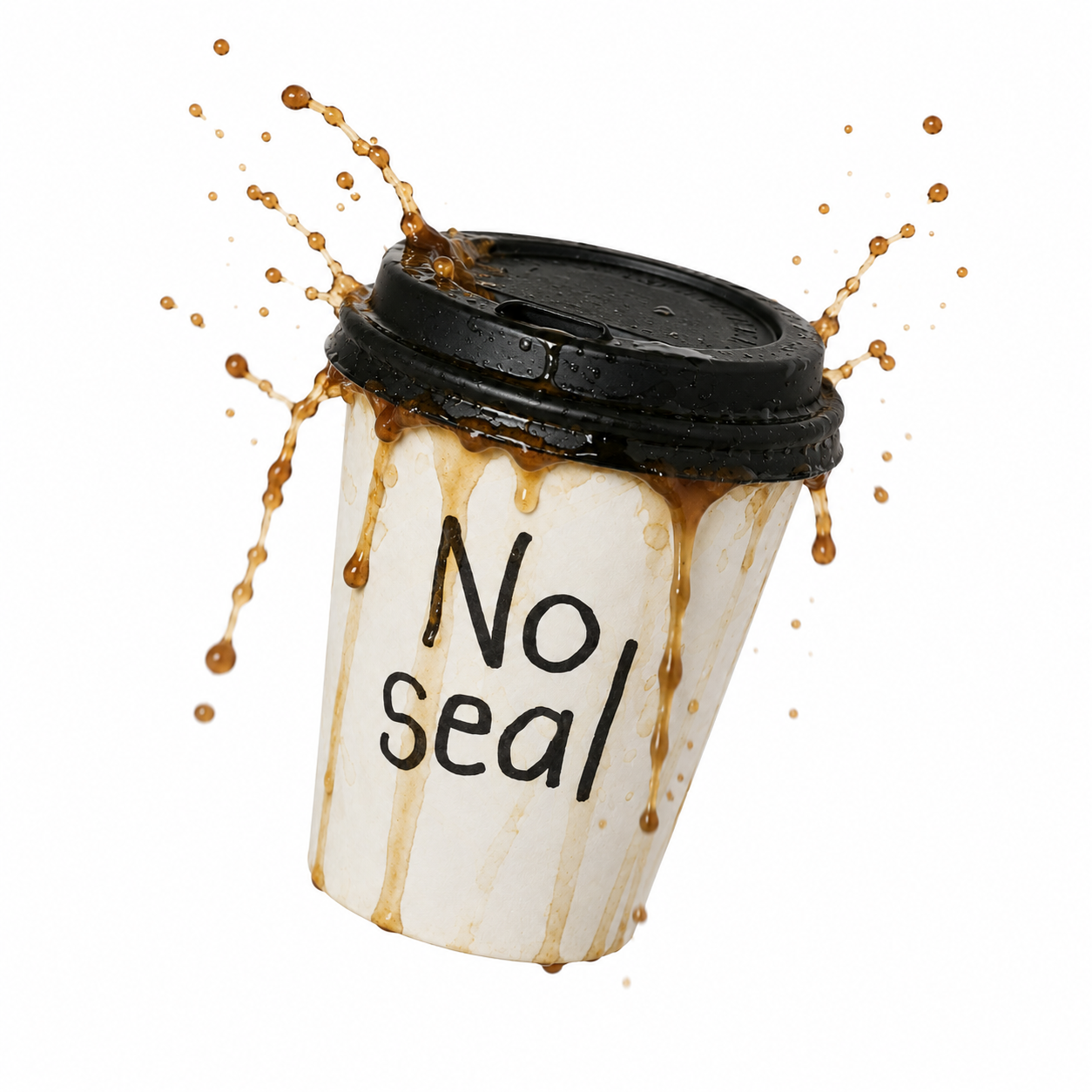
A lid that behaves perfectly on the counter can still arrive at a customer’s door having wept around the rim, drained through the straw hole, or soaked the bag it travelled in. That gap — between how a cup performs in the store and how it performs inside a delivery backpack on a scooter — is why leak proof drink packaging has become one of the most searched terms in foodservice packaging.
It is also one of the most loosely used. Very little packaging is genuinely leak proof under every condition, and any supplier who says otherwise is telling you more about their marketing than their product. What operators actually need is honest information about failure modes, and a way to compare the options against the conditions their own drinks travel in.
This article covers what leak resistance means in practice, the six reasons standard lids fail in transit, the five approaches operators typically try, and a buyer’s checklist you can use before committing to any of them.
THE SHORT ANSWER
Leak proof drink packaging is any packaging method that keeps liquid inside the cup when the cup is tilted, jolted, or subjected to pressure and temperature change during transport.
A standard lid alone rarely achieves this, because a lid is a press-fit closure with a manufacturing tolerance and an open straw port — not a seal. The most reliable results come from adding a physical barrier across the mouth of the cup, underneath the lid, so the lid’s own clamping pressure holds the barrier in place.
The phrase gets used to describe three different properties that are worth separating, because a solution can deliver one and not the others.
Liquid stays inside the cup when the cup is tilted, held at an angle for a sustained period, or moved through vibration and pressure change. This is the property that matters most in delivery, because delivery is mostly sustained movement rather than single dramatic events.
Liquid stays inside the cup when the cup is knocked, tipped, or handled roughly. Spill resistance and leak resistance overlap, but they are not identical: a cup can survive being knocked over and still seep steadily through the straw hole for twenty minutes.
It is visibly obvious whether the cup was opened after preparation. This is a trust and hygiene property rather than a containment one, though the two are often delivered by the same component.
One more piece of honesty is worth building into any procurement conversation: "leak proof" is a category term buyers search for, not an engineering absolute. A credible supplier will tell you the conditions their solution has been tested under — cup types, lid types, orientations, temperatures, durations — rather than claim universal performance. Ask for that detail. The answer tells you a great deal about who you are dealing with.
Cup lids are excellent at the job they were designed for: keeping a drink covered while a customer walks a short distance and drinks from it. Delivery asks something quite different of them.
Lids are press-fitted onto a cup rim, and both components are manufactured within a tolerance range. Cup and lid from the same supplier and the same batch usually fit well. Mixed inventory, a slightly deformed rim from stacking, or a lid seated at a fractional angle by a rushed team member during peak service all reduce that fit. The lid still looks closed. It is no longer sealed.
On cold cups, the straw hole is a deliberate opening in the top of a container full of liquid. A pre-inserted straw does not close it. Tilt the cup past roughly forty-five degrees and the straw hole becomes the lowest available exit.
A hot drink in a sealed insulated bag continues to release steam. As the headspace pressure rises and then cools, air and moisture move through whatever gap exists at the rim. This is why hot drinks frequently arrive with a damp ring around the lid even when the cup was never tipped.
Packaging is often tested by tipping a cup and righting it. Delivery involves a cup leaning against the wall of a bag for fifteen minutes while a scooter accelerates, brakes, and corners. Small gaps that release nothing in a two-second test release a surprising volume over a quarter of an hour.
Iced drinks, milkshakes, and smoothies sweat. A wet cup wall and a wet lid surface are poor substrates for any sticker or tape, which is the single most common reason adhesive-based approaches disappoint in cold-drink service.
Drinks rarely travel alone. A second cup resting against the first, a heavy container of food shifting on top, or continuous vibration across a longer route all work the lid loose from a good fit toward a marginal one.
Use this to compare options on the same terms. The questions that operators most often forget are the ones about workflow, not performance.
Beverage Seal sits in the fifth category above. It is a single-use disc of high wet-strength paper placed onto the rim of the cup before the lid goes on. The lid is then clipped down as normal, and the lid’s own clamping pressure holds the disc flat against the rim.
That mechanism is the point. Rather than adding something on top of the lid — where adhesion is unreliable and the rim gap is untouched — the barrier sits underneath it, across the full mouth of the cup, held by pressure the lid was already applying. This method of use is patented.
In practical terms, that means:
Beverage Seal has been used to seal over ten million drinks to date, including a proof-of-concept with a national food retailer and a pilot with an international quick service restaurant brand, and is in use across Africa, the United Kingdom, the United States, Egypt, and Canada.
The reason leaking drinks stay unsolved in many businesses is that the cost is spread thinly across several budgets and never totalled. A packaging decision is easier to make once it is.
Take any recent thousand delivery orders containing a beverage and total the following:
That last line is usually the largest and almost never appears in a packaging comparison. Prepared beverages tend to carry stronger margins than bottled or canned alternatives, so a delivery menu narrowed by spill anxiety is a revenue decision as much as an operational one.
Divide the total by a thousand and you have a cost per order that any packaging option can be measured against. Most operators find the honest figure is considerably higher than the unit cost of the packaging being debated.
Leak proof drink packaging is not a single product category, and no responsible supplier will tell you their solution is leak proof in every condition. What separates a good decision from a bad one is knowing which failure mode you are actually trying to fix.
If drinks are arriving tipped over and knocking into food, position is the problem and a carrier helps. If drinks are arriving upright but damp — a wet ring around the lid, a soggy bag, liquid tracked down the side of the cup — the problem is containment at the rim and the straw hole, and only a barrier across the mouth of the cup addresses that.
Test whichever option you choose the way your drinks actually travel: filled to normal level, lidded by a team member during a real rush, laid on its side inside a delivery bag for fifteen minutes, and carried over a genuine route. That test costs almost nothing and is far more informative than any specification sheet.
The fastest way to know whether a sealing insert solves your leak problem is to try it on the cups and lids you already stock, in the conditions your drinks already travel in.
Request a sample pack to test against your current setup, or speak to the Beverage Seal team about running a measured store-level trial across your delivery orders.
Leak proof drink packaging is any packaging method that keeps liquid inside the cup while the drink is transported — including when the cup is tilted, vibrated, or subjected to pressure and temperature change. In practice it usually means adding a barrier across the mouth of the cup rather than relying on the lid alone, because a lid is a press-fit closure with a manufacturing tolerance and, on cold cups, an open straw port.
No lid is leak proof under all conditions. Lids and cups are manufactured within tolerance ranges, so the quality of the fit varies with batch, stacking damage, and how carefully the lid was seated. Treat "leak proof" as a category description rather than an absolute guarantee, and ask any supplier what conditions their solution has actually been tested under.
The most reliable approach is to place a barrier across the full mouth of the cup underneath the lid, so the lid’s clamping pressure holds it in place. This addresses the two main leak paths at once: the gap at the rim and the straw hole. Supporting measures help too — not overfilling cups, keeping cups upright in a carrier, and matching lids to the correct cup size.
Not on their own. A sticker across the lid provides tamper evidence and covers the straw hole, but it does not create a barrier across the cup mouth, so seepage at the rim continues. Adhesive performance also drops on condensation from iced drinks and on hot, steaming lids, which is where stickers most often disappoint.
Yes. Hot drinks need a sealing material that holds up to steam and moisture without softening. Beverage Seal uses a high wet-strength paper suited to both hot and cold beverages, so coffee, tea, and hot chocolate can be sealed with the same method as iced drinks and milkshakes.
Not necessarily. Heat-seal film systems require a cup sealing machine, power, counter space, and maintenance. An insert placed between the cup and the lid requires no equipment at all — the lid provides the pressure that holds the seal — which makes it considerably easier to roll out across multiple sites.
With a Beverage Seal, the customer pushes a straw straight through the seal when they are ready to drink. The barrier stays intact for the whole journey and only opens at the point of consumption. For hot drinks, the lid and seal are removed together.
It depends on the material. Plastic heat-seal films and additional plastic lids add to plastic volume per drink. Beverage Seal is a paper-based seal that is recyclable, compostable and biodegradable, and it also reduces the packaging waste created by failed deliveries — remade drinks, replacement orders, and the food discarded alongside them.