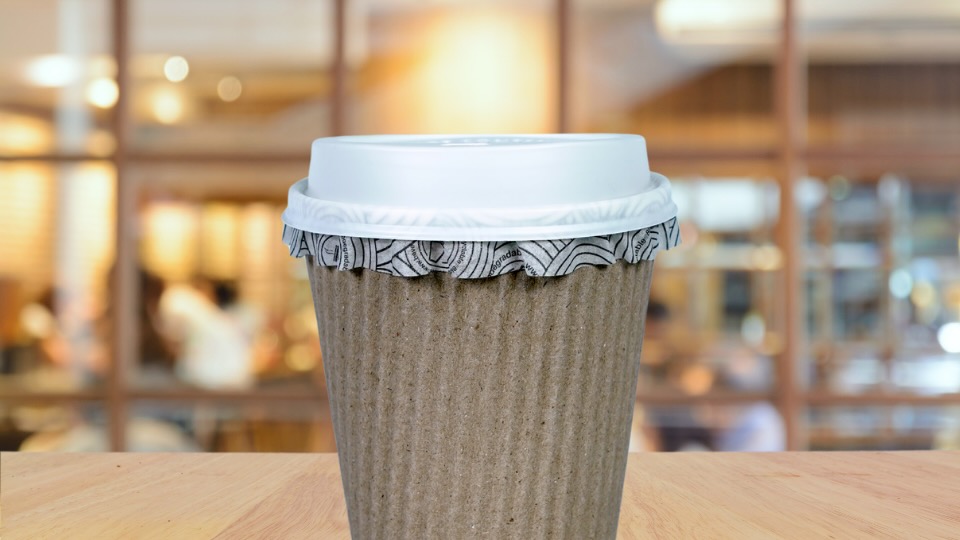
Coffee is the drink customers are most particular about and the one that travels worst. A flat white that would be faultless across the counter can arrive twenty minutes later lukewarm, with a damp ring around the lid and a wet patch on the paper bag it shared with a pastry. Nothing catastrophic has happened. The customer simply will not order coffee from you again.
That is the difficult thing about coffee delivery packaging. The failures are rarely dramatic. They are small, cumulative, and they erode exactly the thing a coffee brand sells — the sense that someone made this carefully.
This guide covers why hot drinks are harder to deliver than cold ones, the four points where coffee orders actually fail, what to fix in what order, and how to evaluate packaging without buying the first thing a supplier demonstrates.
THE SHORT ANSWER
Coffee delivery has three separate problems: containment, temperature, and presentation. Most operators try to solve all three with one purchase and end up solving none of them well.
Fix containment first. A cold coffee is a disappointment; a leaked coffee ruins the whole order and generates a refund. Containment is also the cheapest of the three to fix, because it does not require equipment or a change to your delivery logistics.
Iced drinks have their own difficulties, mostly to do with condensation and dilution. But hot coffee introduces physics that cold drinks do not.
A freshly poured coffee continues to release steam after the lid goes on. In an insulated delivery bag, that vapour has nowhere to go, so pressure builds in the headspace and then drops as the drink cools. Air and moisture move through whatever gap exists at the rim in both directions. This is why hot drinks frequently arrive with a wet lid even when the cup was never tipped over — the liquid was pushed out, not spilled.
Paper cups gain a small amount of flex when hot, and the plastic lid warms with them. The fit that felt firm at the counter is marginally looser five minutes into the journey.
Any sticker-based approach is applied to a lid that is warm and about to be covered in condensation. This is the single most common reason cafes report that tamper stickers "worked in testing" and then did not hold in service.
A hot drink starts losing heat immediately and delivery adds twenty to forty minutes. Packaging can slow this considerably, but no cup or seal reverses it, which is why temperature has to be managed through the whole journey rather than at the cup alone.
This matters more than it sounds. A cup carrier is genuinely useful for four drinks and nearly pointless for one, and a large share of coffee delivery is one drink, sometimes with a pastry. For most cafes the packaging that pays for itself is the packaging that works on a single cup.
It helps to be precise about where things go wrong, because each point has a different fix and they are usually addressed in the wrong order.
Read the last thirty coffee-related complaints against that table before spending anything. "Arrived cold" points at the bag. "Everything was soaked" points at the rim. The two require completely different purchases, and buying the wrong one is how cafes conclude that nothing works.
Common, and it does help with heat and with handling a hot cup. It does nothing at all about leakage — the rim gap on the inner cup is unchanged — and it doubles cup cost and waste per drink.
A second lid pressed over the first covers the drinking aperture and adds a friction point. It slows the beverage station, adds material cost, and depends on the second lid seating properly. The primary rim gap is untouched.
Useful for tamper evidence, unreliable on hot lids for the adhesion reasons above, and not a containment solution regardless of how well they stick.
Genuinely valuable on multi-drink orders, where they stop cups levering each other’s lids off and keep drinks away from food. Close to useless on the single-cup orders that make up much of coffee delivery, and they take significant space in a bag.
The right answer to the temperature problem, and worth investing in if "arrived cold" dominates your complaints. They do not contain liquid, and a leak inside an insulated bag is a considerably worse mess than a leak in a paper bag.
Addresses the rim and the aperture together, works on a single cup, and needs no equipment. It does not keep the drink hot and it does not stop the cup falling over, so it sits alongside insulation and carriers rather than replacing them.
If budget and attention are limited, this order tends to produce the best return for a coffee business.
The common mistake is starting at step five, because presentation is the most visible and the easiest to specify. A beautifully branded cup that arrives wet is worse than a plain one that arrives dry.
Beverage Seal is a single-use disc of high wet-strength paper placed onto the cup rim before the lid goes on. The lid is clipped down as normal and its own clamping pressure holds the disc flat across the mouth of the cup. This method of use is patented.
For a coffee operation specifically, the relevant points are:
Beverage Seal also supplies thermal delivery boxes for operators whose primary problem is heat loss rather than leakage, which are a separate answer to a separate problem.
Beverage Seal has been used to seal over ten million drinks to date, including a proof-of-concept with a national food retailer and a pilot with an international quick service restaurant brand, and is in use across Africa, the United Kingdom, the United States, Egypt, and Canada.
Packaging decisions in coffee tend to be made on cents per cup, which is the wrong denominator. Two figures are more useful.
Take a recent thousand delivery orders containing coffee. Total the refunds where a drink was the cause, including whole-order refunds when a leak damaged food; the remade drinks and their ingredient cost; the staff time spent handling complaints; any replacement deliveries; and the reviews that mention a spilled or soaked order. Divide by a thousand. That figure, not the unit price, is what a packaging option has to beat.
Many cafes quietly restrict what they will send out — no iced drinks with tall domes, no full-cup americanos, sometimes no hot drinks beyond a certain distance. Each restriction is margin you have chosen not to earn, and prepared coffee usually carries a stronger margin than the bottled alternatives customers order instead. If better packaging lets you put those drinks back on the delivery menu, that revenue belongs in the calculation — and it is frequently larger than the entire packaging cost.
Supplier demonstrations are done with a fresh cup, a careful hand, and a short journey. Yours should not be.
That last point does most of the work. Most operators cannot say what proportion of their delivery complaints are beverage-related, because the categories were never separated. Tagging them for a month costs nothing and usually settles the packaging argument on its own.
The only comparison that matters is the one run on your cups, your lids, your baristas and your routes.
Request a sample pack to test against your current setup, or speak to the Beverage Seal team about designing a thirty-day trial with measurable outcomes across your delivery orders.
There is no single answer, because coffee delivery has three separate problems. Containment is addressed by a barrier across the mouth of the cup, held under the lid. Temperature is addressed by insulated bags or thermal boxes. Position is addressed by a carrier on multi-drink orders. Most cafes get the best return by fixing containment first, because a leak damages the whole order and usually triggers a refund.
A hot drink keeps releasing steam after the lid is fitted. Inside a closed delivery bag the pressure in the headspace rises and then falls as the coffee cools, pushing liquid and vapour through whatever gap exists between the cup and lid. The cup never has to tip over for the lid to arrive wet.
The most reliable method is to place a barrier across the mouth of the cup before the lid goes on, so the lid’s clamping pressure holds it against the rim. This closes the rim gap and the lid opening at the same time. Not overfilling the cup and matching lids to the correct cup size both help, but neither addresses the underlying gap.
Less reliably than on dry surfaces. A hot lid is warm and quickly becomes damp with condensation, which is a poor substrate for adhesive. Stickers also cover the drinking aperture without closing the gap at the cup rim, so they address tamper evidence rather than leakage.
Temperature is managed across the whole journey rather than at the cup. Insulated delivery bags and thermal boxes make the largest difference, followed by reducing the time between preparation and courier collection. Sealing the cup helps slightly by limiting vapour loss, but it is not a temperature solution and should not be bought as one.
On multi-drink orders, yes — they stop cups knocking into each other and levering lids loose, and keep drinks clear of food. On single-cup orders, which are a large share of coffee delivery, a carrier adds bulk and cost without addressing the way coffee actually fails. It manages position, not containment.
A seal placed between the cup and lid does not touch the coffee’s composition. What it changes is what arrives: less vapour lost during the journey, no liquid tracked down the outside of the cup, and a drink the customer has not had to wipe down before drinking.
A mixed coffee menu is easier to manage with one sealing method rather than a different approach per drink. Beverage Seal uses a high wet-strength paper suited to both, so hot coffee, tea and hot chocolate can be sealed the same way as iced coffee, cold brew and blended drinks. For iced drinks the customer pushes a straw through the seal; for hot drinks the lid and seal come off together.