By Johann Peek, CEO of Beverage Seal, June 2026
Food packaging, delivery menus and third-party logistics have evolved. Prepared beverages still expose one of the most visible gaps in the off-premise experience.
Delivery is no longer the side channel of the restaurant business. For many QSRs, coffee chains, ghost kitchens, convenience retailers and foodservice operators, it is one of the front doors.
The National Restaurant Association's 2025off-premises dining reporting put the shift in clear terms: nearly 75% of all restaurant traffic now happens off-premises. That includes takeout, drive-thru and delivery - the channels where the customer experience is increasingly defined by what arrives in the bag.
Foodservice operators have responded. Digital ordering has become smoother. Delivery menus have become more disciplined. Food packaging has improved. Third-party logistics are now part of the operating model, not just an emergency workaround. DoorDash's 2025 results reinforce the scale of demand: the company reported 732 million total orders inQ1 2025 and 761 million total orders in Q2 2025, up 20% year over year in Q2.
But one part of the off-premise dining experience still exposes the gap between promise and reality: the drink.
For operators evaluating beverage deliverypackaging, that gap matters. Prepared beverages are liquid, visible,spill-prone and closely tied to customer trust. When a drink arrives clean,sealed and intact, it supports the entire order experience. When it leaks,spills or feels exposed, the damage can spread far beyond the cup.
Beverages behave differently from food indelivery. A sandwich can be wrapped. A bowl can be lidded. Fries can be vented.A salad can be compartmentalized. Operators can engineer food menus around whattravels well and remove items that do not.
A prepared beverage is different. It moveswhen the car brakes. It leans when the courier turns. It sloshes against thelid. It can reveal every weakness in the cup, lid, carrier, bag and handoffprocess.
It is also highly visible. A customer maytolerate food that shifts slightly in transit, but a leaking coffee, tippedfountain drink, melted smoothie or exposed iced beverage immediatelycommunicates carelessness. The customer does not need to understand theoperational chain to judge the result. The cup tells the story.
Many operators reduce beverage delivery risk by defaulting to bottles and cans. That can make sense in some situations. Bottled and canned drinks are stable, familiar and easier to transport. They reduce some spill risk and simplify store execution.
But they also create a commercial trade-off. A bottled soda or canned beverage may travel more easily, but itweakens margin opportunity, reduce differentiation and shift the customerperception from 'this is part of the restaurant experience' to 'this is a commodity I could have bought somewhere else.'
For QSRs, coffee chains, convenience retailers, ghost kitchens and delivery-first brands, prepared beverages are often where brand, habit, impulse and margin come together. Fountain drinks, coffee, teas, iced beverages, smoothies, shakes and specialty drinks can strengthen the basket - but only if the operator can deliver them with confidence.
The goal is not to eliminate bottles and cans. They have a role. The better question is whether spill risk should force operators away from higher-value prepared beverages that could otherwise support growth, repeat orders and brand preference.
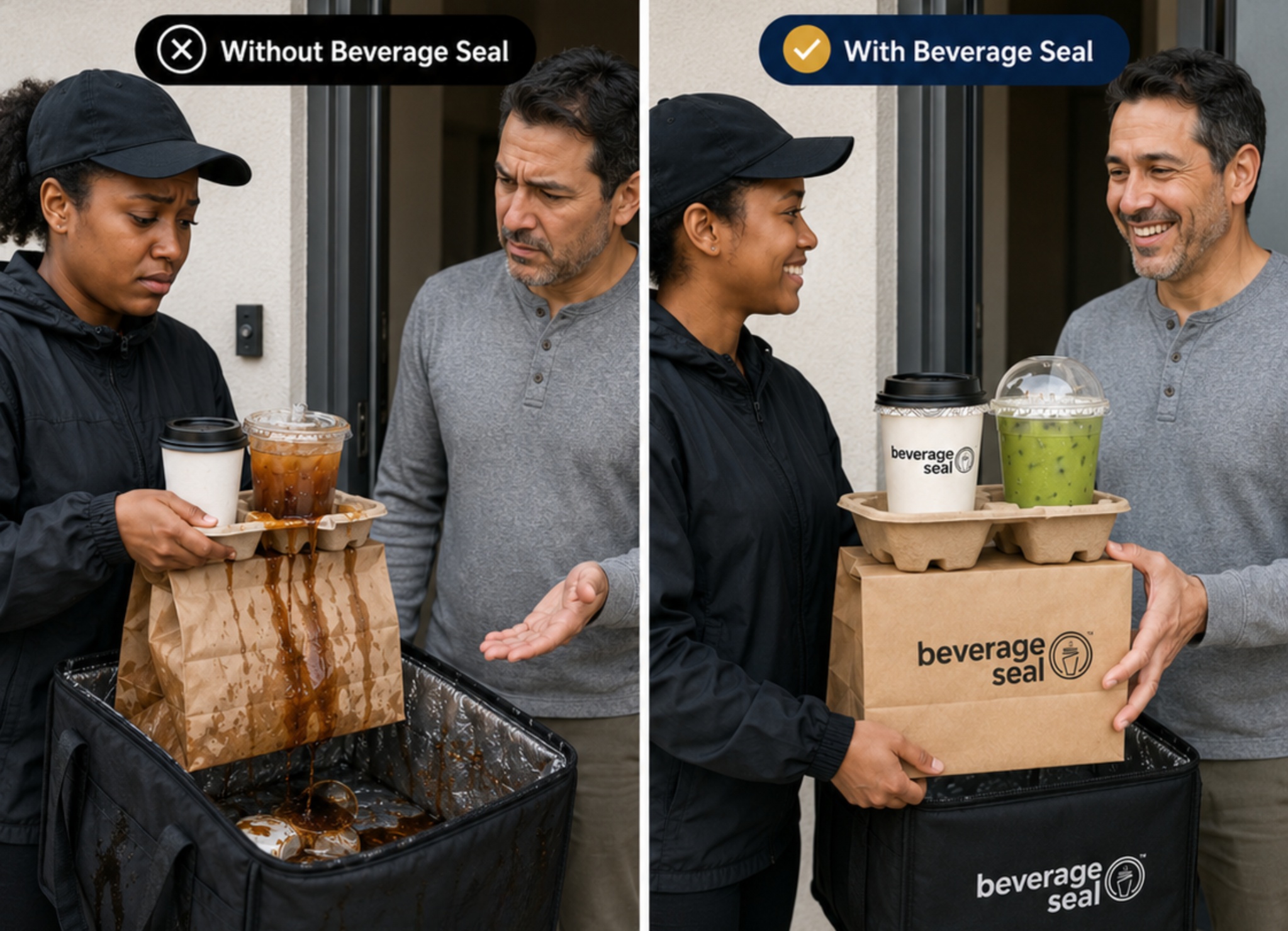
A leaking coffee does not stay a leaking coffee for long. It becomes a wet bag, a damaged meal, a frustrated courier, a refund request, a poor review and a customer wondering whether the order was handled with care.
A fountain drink that arrives exposed or poorly protected can make the customer question the whole order, not just the beverage. A smoothie or iced drink that spills inside a delivery bag can turn a profitable basket into a brand problem.
This is why drink delivery packaging should not be treated as a minor operational detail. It touches complaint reduction, refund risk, remake cost, courier handoff, beverage attachment, packaging waste, franchise consistency and brand presentation. In many delivery journeys, the beverage is the most fragile part of the order - and the easiest failure for the customer to notice.
Starbucks offers a useful signal. When the company expanded delivery with Grubhub, it said it had developed multiple packaging solutions, including two-cup to-go trays and improved shopper bags, to support delivery quality and help drivers transport multiple beverages. Starbucks later added DoorDash-powered delivery into the Starbucks app in the U.S. and Canada.
For a beverage-led brand, delivery was not treated as simply putting a cup in a bag. It required packaging, logistics anddigital experience to work together.
The broader delivery market reinforces thepoint. DoorDash's 2025 order growth shows that delivery demand remains largeand structurally important. At the same time, operators are reminded thatdelivery execution can affect restaurant trust, reputation and customerperception even when the restaurant does not control every part of the journey.
It is important to note that customers donot neatly separate the restaurant, the platform, the courier, the packagingand the arrival experience. When something goes wrong at the door, the brandoften absorbs the blame.
Most operators already use some combinationof lids, cup carriers, trays, stickers, bags and staff handoff routines. Eachcan help. None should be dismissed. But each has a limitation.
· Standard lids provide closure,but they may not be enough for the motion of delivery.
· Cup carriers help stabilizedrinks, but they do not seal them.
· Stickers and tape can provide atamper-evident cue, but they do not necessarily control liquid movement.
· Separate bags can isolatebeverages, but they may also hide a leak until the customer opens the order.
· Double-lidding or extrapackaging may reduce risk, but it can add cost, complexity and waste.
· Bottles and cans reduce spillrisk, but can limit prepared beverage margin and brand differentiation.
The next step is not simply more packaging.It is better beverage-specific packaging designed for the real journey: storeto shelf, shelf to courier, courier to car, car to customer, customer to firstsip.
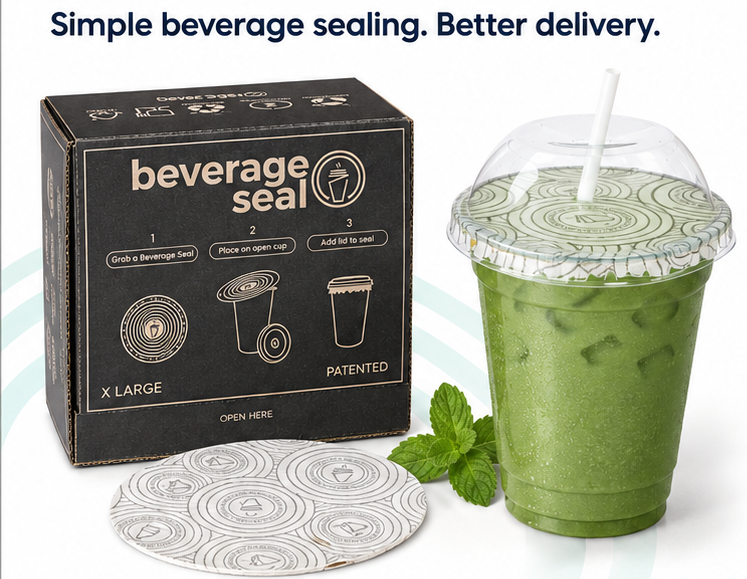
Beverage Seal is a simple, no-equipmentinsert placed between the cup and lid. It is designed to help make takeaway anddelivery beverages more spill-resistant and tamper-evident, adding a practicallayer of protection as the cup moves through the off-premise journey.
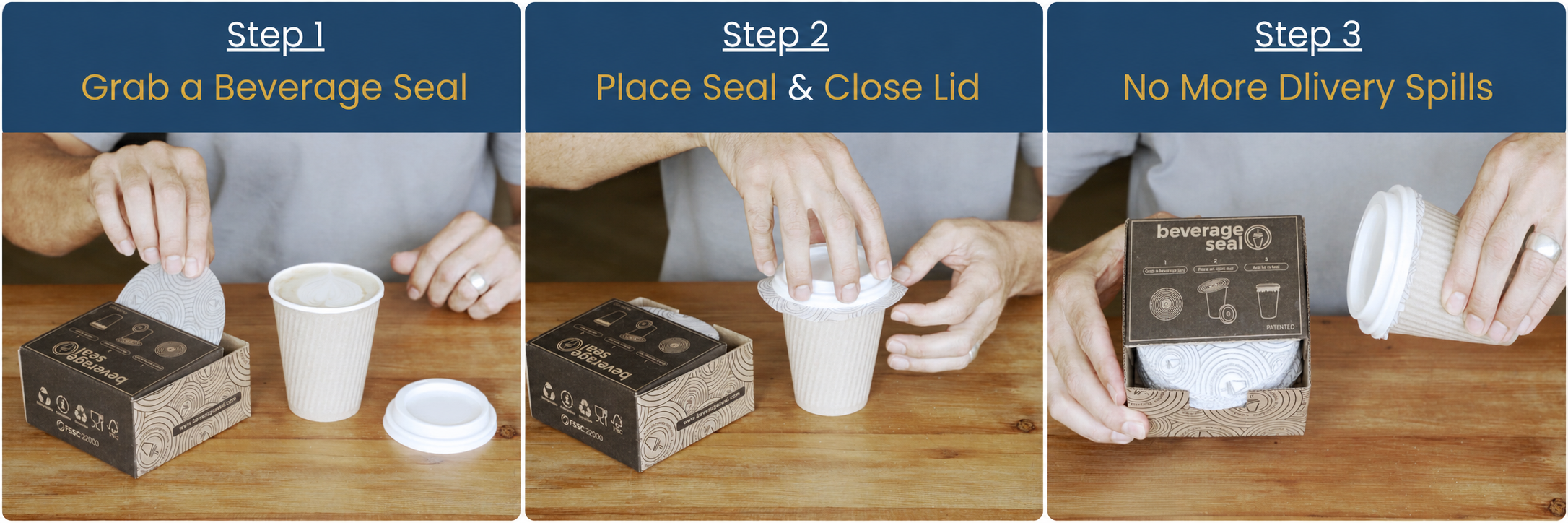
The process is straightforward: place the insert on the open cup, apply the lid and complete the seal. Beverage Seal is designed for hot and cold drinks and does not require a machine, making it relevant to busy QSR, coffee, convenience retail, ghost kitchen and restaurant environments.
The value is not only that the drink is better protected. It is that the operator creates a more professional beverage handoff, the customer receives a more confidence-building cup, and the brand has one more controllable element in a delivery experience that can otherwise feel fragmented.
For senior leaders, the opportunity is to look at beverages not as side items, but as a delivery growth lever. For procurement teams, it means evaluating total cost of failure, not only unit cost. For operations teams, it means testing packaging in real movement conditions, not just at the counter. For marketing and customer experience teams, it means recognizing that a sealed, clean, well-presented drink communicates care before the first sip.
A practical packaging review should include questions such as:
· Which prepared beverages are currently limited by delivery concerns?
· Where do spill-related complaints, refunds or remakes appear in the data?
· Does the current cup and lid combination perform under real courier movement?
· Do stickers, carriers and bags solve both tamper evidence and liquid movement?
· How much staff time is added by workarounds such as double-lidding or extra bagging?
· Does the beverage arrive in away that supports the brand's intended customer experience?
· Could a store-level test compare current packaging with a sealed beverage setup?
The last frontier of food delivery may not be another app feature, discount or loyalty mechanic. It may be the physical arrival experience.
A dry bag. An intact order. A protected drink. A customer who feels the brand thought through the journey.
For operators serious about off-premises growth, now is the time to ask a simple question: has your beverage delivery packaging kept pace with your delivery strategy?
Review the current setup. Compare lids, stickers, carriers, bottles, cans, bags and beverage seals. Look at spill-related complaints, refunds, remakes and customer feedback. Test the journey the way customers actually experience it.
Then decide whether the drink is still the weak link - or the next opportunity.
Beverage delivery packaging includes the cups, lids, trays, carriers, bags, seals and handoff systems used to protect prepared drinks during takeaway, pickup, drive-thru and delivery. Strong beverage delivery packaging should account for movement, visibility, spill resistance, tamper evidence, customer confidence and store-level ease of use.
Drinks spill during delivery because liquid moves with every stop, turn, tilt and handoff. Standard lids, carriers and bags may help, but courier movement, bag placement, cup fit and lid fit can still create leaks, sloshing or lid failures.
Cup carriers are useful because they help stabilize drinks, especially when multiple beverages are being transported. However, carriers do not seal the cup. For delivery, many operators may need both stabilization and a stronger layer of drink protection.
Bottles and cans remove spill risk, but they also limit prepared beverage margin, brand differentiation and menu experience. Prepared fountain drinks, coffees, iced drinks, smoothies, teas and specialty beverages can be valuable delivery items when the packaging supports the journey.
A tamper-evident drink seal is packaging that gives customers a visible cue that the beverage has remained protected after preparation. For delivery and pickup, tamper evidence can support hygiene perception, customer confidence and brand trust.
Beverage Seal is placed on the open cup before the lid is applied. The lid completes the seal, creating a no-equipment insert between the cup and lid that helps make takeaway and delivery beverages more spill-resistant and tamper-evident.